If you're nervous about booking a hearing test, here's the most important thing to know: a hearing test is completely painless, and a full appointment takes about an hour. There are no needles, no invasive procedures, and nothing that requires recovery time. The Cleveland Clinic puts it plainly: hearing tests don't hurt, and they don't require any preparation [1].
Most of the appointment is simply a conversation. The testing itself involves sitting in a quiet room, listening to tones and words, and pressing a button when you hear them. You get your results the same day, explained face to face, and you leave knowing exactly where your hearing stands [1, 4].
A comprehensive hearing evaluation follows a predictable sequence: a conversation about your hearing history, a quick look inside your ears, a series of listening tests in a sound booth, and a review of your results. At Virsono Hearing Centers, that full visit, including time to talk through what the results mean for you, runs 60 to 90 minutes, with no pressure and no obligation at the end.
This guide walks through each step, so nothing on the day comes as a surprise.
Before your appointment: how to prepare
There's no real preparation required for a hearing test [1]. But a few things make the visit more useful:
- A list of your medications. Some medications can affect hearing, so your audiologist will want to know what you take [4].
- Your current hearing aids, if you have any, even old ones sitting in a drawer.
- Notes on when hearing is hardest. Restaurants? Phone calls? The TV? Concrete examples help your audiologist connect test results to real life.
- A family member or friend. The people close to you often notice listening difficulties before you do, and a familiar voice is genuinely useful during testing.
One more practical note: if you've had a cold or ear pain recently, mention it when you book. Congestion can temporarily affect results.
Step 1: A conversation about your hearing
Every good hearing evaluation starts with listening: to you. Your audiologist will ask about your medical history, family history of hearing loss, noise exposure from work or hobbies, medications, and any ringing in your ears [3, 4].
Just as important, they'll ask what hearing difficulty is actually costing you. Do you avoid restaurants? Ask people to repeat themselves? Turn the TV up louder than the rest of the household likes? At Virsono, this discovery conversation shapes everything that follows. The goal isn't just to measure your ears, but to understand when, where, and how you want to hear better.
Step 2: A look inside your ears
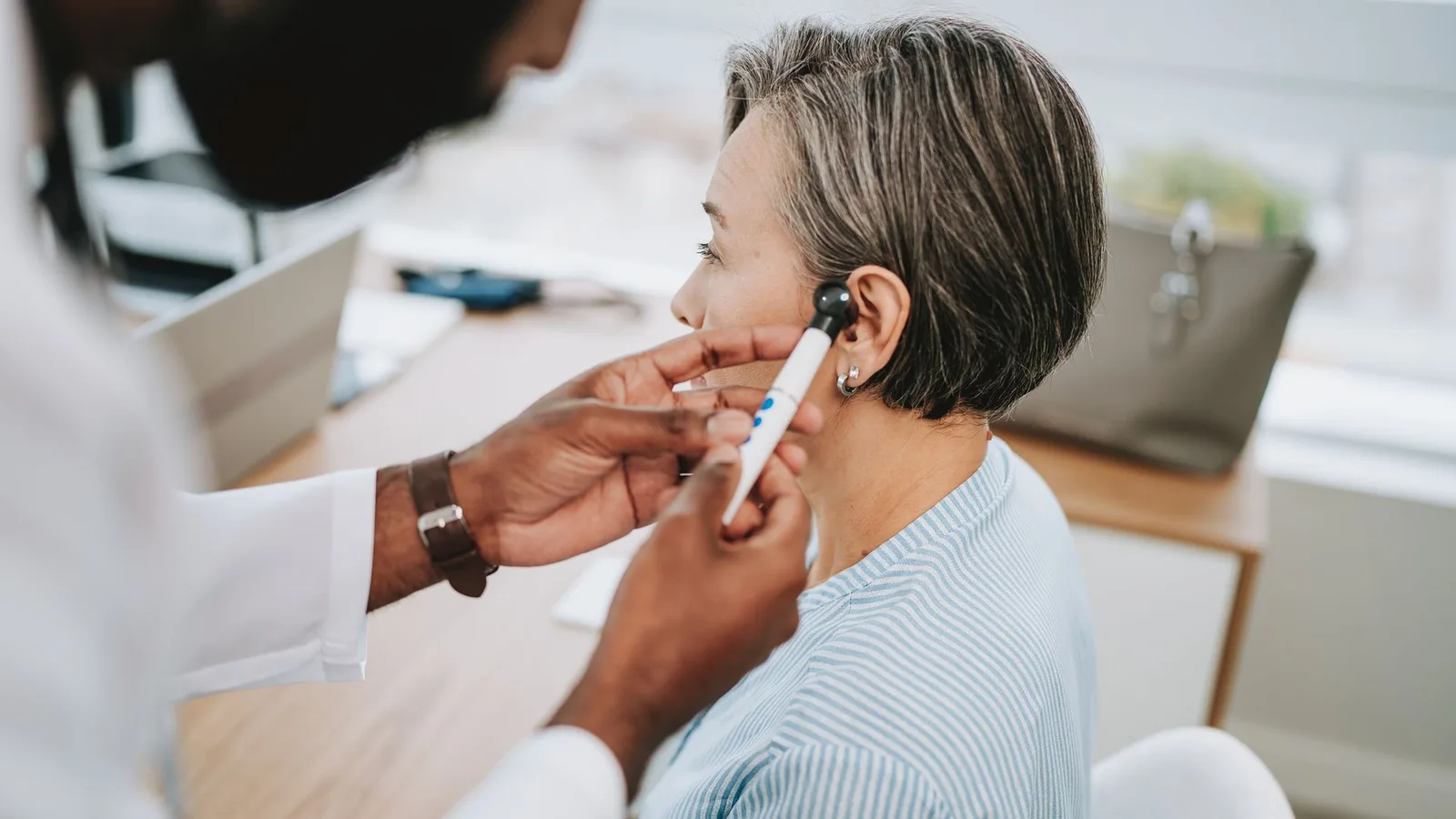
Next comes otoscopy, a painless visual exam of your ear canals and eardrums using a small lighted instrument called an otoscope [3, 4]. This takes a minute or two per ear.
It matters because some hearing problems have simple physical causes: earwax buildup, fluid, or signs of infection [4]. If something like wax is blocking the canal, it needs to be addressed before testing, and occasionally it turns out to be a big part of the problem.
Step 3: The sound booth
This is the part most people picture when they think "hearing test." You'll sit in a quiet, specially built room wearing headphones or earphones, and respond to what you hear [3]. Several tests happen here.
Pure-tone testing
You'll hear a series of tones, from low pitches up to very high ones, played one ear at a time and getting progressively softer. Each time you hear one, you press a button, raise your hand, or say "yes" [2]. This finds the quietest sound you can hear at each pitch, across the range that matters most for everyday listening [1, 2].
Some tones will be too faint for you to hear. That's by design: the test is looking for your limits, so don't worry about "failing" individual beeps.
Bone conduction testing
For this test, a small device rests on the bone behind your ear and delivers gentle vibrations directly to your inner ear, bypassing the eardrum and middle ear [2]. It doesn't hurt; it feels like a faint buzz.
Comparing bone conduction results with the headphone results tells your audiologist where any hearing loss is coming from: the middle ear (conductive loss, which is sometimes medically treatable), the inner ear or hearing nerve (sensorineural loss, the most common type in adults), or both [2].
Speech testing
Hearing beeps is one thing; understanding people is another. In speech testing, you'll listen to words at different volumes and repeat them back [1, 2]. Many evaluations also test speech with background noise, because that's where real-world listening tends to break down [4].
Tympanometry
Your audiologist may also perform tympanometry, a quick, painless check of your eardrum. A soft probe rests at the opening of your ear canal and applies slight changes in air pressure to measure how well the eardrum moves, which can reveal fluid or pressure problems in the middle ear [1, 2]. You'll feel a brief sensation of fullness, similar to pressure changes on an airplane.
How Virsono tests the ear-to-brain connection
Here's something many people don't realize: hearing happens in your ears, but listening happens in your brain. Detecting sound and decoding meaning are two different jobs. That's why two people with identical audiograms can have very different experiences in a noisy restaurant.
Virsono's evaluation is built around this ear-to-brain connection. Alongside standard audiometry, your visit includes speech-in-noise testing and a cognitive screening: a look at how well your ears and brain are working together, not just how faint a beep you can detect. The results are then connected directly to the goals you described in Step 1. You can read more about this four-step approach on our process page.
Step 4: Your results, explained the same day
Hearing test results aren't sent off to a lab. Your audiologist scores them as you go and walks you through everything before you leave [1, 4].
The centerpiece is your audiogram, a chart of the softest sounds you can hear at each pitch [1]. Reading one is simpler than it looks:
- Left to right runs pitch, from low (a bass hum) to high (birdsong, the consonants "s" and "f").
- Top to bottom runs volume, from very soft to loud.
- Marks for each ear show the quietest level you detected at each pitch. The lower a mark sits on the chart, the more hearing loss at that pitch [1, 2].
Many adults show a familiar pattern: good hearing for low pitches, declining at high pitches. That's why voices can seem plenty loud but words sound mumbled. The high-pitched consonants that make speech crisp are the first to fade. Your audiogram, combined with your speech scores, shows the type and degree of any hearing loss and points to the right next step [2, 3].
What happens if the test finds hearing loss?
First: nothing happens that you don't choose. A diagnosis is information, not a commitment.
If your results show hearing loss, your audiologist will explain what kind, how significant, and what your options are. Depending on the cause, that might mean medical referral (for something treatable like wax or fluid), monitoring with a follow-up test, or treatment, which could include hearing aids, assistive listening devices, or counseling. Your lifestyle, your goals, and your budget all shape the recommendation [3].
At Virsono, the review conversation is explicitly no-pressure: no upsell, no same-day-sale tactics. You leave knowing more about your hearing than you did walking in, whether or not you decide to treat it, and whether or not you decide to treat it with us.
And if your test comes back normal? That's a win too. You'll have a baseline on file, which makes any future changes much easier to spot.
Frequently asked questions
How long does a hearing test take?
Plan for about an hour. The booth testing itself is often 30 minutes or less; the rest is conversation and results review. At Virsono, a full evaluation with consultation runs 60 to 90 minutes, because rushing the "what does this mean for me" conversation defeats the purpose.
Do I need a referral to get a hearing test?
Usually not; you can book directly with an audiology clinic. The exception is insurance: Medicare Part B covers diagnostic hearing exams when a doctor or other provider orders them, though Medicare now also allows one visit to an audiologist every 12 months without an order for non-acute hearing concerns [5]. Some private and Medicare Advantage plans have their own referral rules, so check your plan if you want the test billed to insurance.
How much does a hearing test cost?
It varies more than it should. Plan on roughly $50 to $300 for a baseline hearing test without insurance, depending on the clinic, your region, and the tests included; some national estimates run as low as $18 to $85 on average [6]. If a doctor orders the test, insurance often covers it as a diagnostic service; under Medicare Part B you'd typically pay 20% after your deductible [5, 6]. The honest advice: call the clinic and your insurer first and ask. Reputable clinics will tell you plainly.
How often should I get my hearing tested?
The American Speech-Language-Hearing Association recommends adults get screened at least every decade through age 50, and every 3 years after that [7]. If you work somewhere loud (construction, factory floors, music), annual testing is the standard advice [1]. And if you've noticed a change, don't wait for an interval: sudden hearing loss in particular warrants urgent medical care.
What if I'm not ready for an in-person appointment?
Start smaller. A free online hearing test takes a few minutes at home and gives you a rough read on whether a full evaluation is worth your time. It's a screening, not a diagnosis, but it's a low-commitment first step, and many people find it makes booking the real thing feel easier.
The unknown is the hardest part
Most people wait years between noticing hearing changes and getting tested, and fear of the unknown is a real piece of that. But now you know: a conversation, a look in your ears, some beeps and words in a quiet booth, and an honest explanation of the results. Painless, about an hour, and you're in control of every decision afterward.
If you're ready to know where your hearing stands, find your nearest Virsono clinic and book a comprehensive evaluation. One unhurried hour, and the unknown stops being unknown.
Sources
- Cleveland Clinic, "Hearing Test": https://my.clevelandclinic.org/health/diagnostics/24104-hearing-test
- American Speech-Language-Hearing Association (ASHA), "Types of Hearing Tests": https://helpingyoucommunicate.org/article/types-of-hearing-tests
- American Academy of Audiology, "Hearing Loss Tests": https://www.audiology.org/consumers-and-patients/children-and-hearing-loss/hearing-loss-tests/
- AARP, "What to Expect at a Hearing Exam": https://www.aarp.org/health/conditions-treatments/what-happens-during-hearing-test/
- Medicare.gov, "Hearing & Balance Exams": https://www.medicare.gov/coverage/hearing-balance-exams
- Aflac, "How Much Does a Hearing Test Cost With and Without Insurance?": https://www.aflac.com/resources/health-insurance/hearing-test-cost-with-and-without-insurance.aspx
- ASHA Panel on Audiologic Assessment, "Guidelines for Audiologic Screening": https://www.iup.edu/assets/units/so_-_sz/communication_disorders_special_education_and_disability_services/programs/guidelines-for-audiologic-screening.pdf